

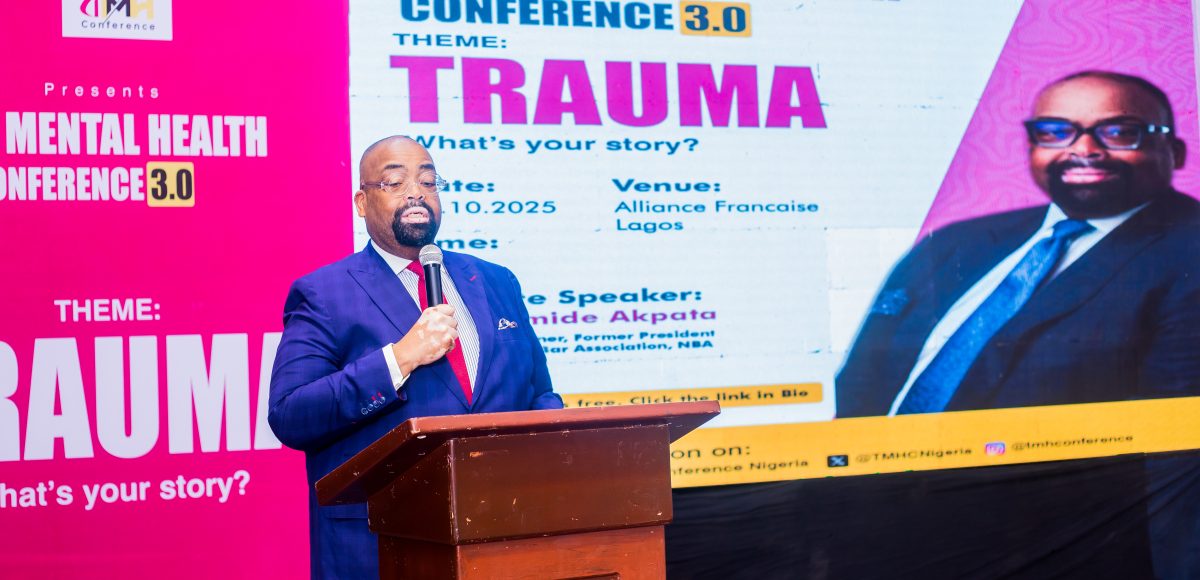
5 Things We Learned from Olumide Akpata at The Mental Health Conference
When Olumide Akpata, former President of the Nigerian Bar Association, took the stage at The Mental Health Conference, he did not come to make a political statement — he came to make a human one. Speaking to an audience of professionals, policymakers, and everyday people gathered under the theme “Trauma: What’s Your Story?”, Akpata examined how justice, governance, and public wellbeing are intertwined.
He reminded listeners that the crises dominating Nigeria’s headlines — insecurity, unemployment, inflation, corruption — are not just socio-economic problems; they are sources of collective trauma. “We cannot build a prosperous society on the foundation of a traumatized, anxious, and broken people,” he said, urging both leaders and citizens to rethink what resilience and justice mean in a time of national strain.
1. Mental health matters — even when you can’t see it.
“Mental health is often dismissed because it is invisible, yet these invisible conditions affect productivity more severely than physical illness.” Akpata drew attention to the cost of invisibility: when society overlooks mental suffering because it leaves no visible wound, the damage only deepens.
In workplaces, public offices, and even homes, invisible pain silently drains creativity, focus, and morale. His call was for a cultural shift — one that validates emotional distress as real and deserving of care, not concealment.
2. Trauma doesn’t disappear; it is inherited.
“Trauma doesn’t simply disappear, it lives in the body, shapes behavior, and then passes from generation to generation.” Akpata’s framing of trauma was both scientific and moral.
He spoke to how unhealed wounds — from domestic violence to systemic injustice — imprint on families and societies. Healing, he argued, cannot remain a private act; it must become a public agenda. Breaking these cycles requires policy reforms, education, and access to care that interrupt transmission before it becomes legacy.
Read Also: 5 Things We Learned from Dr. May At The Mental Health Conference 3.0
3. A broken people cannot build a thriving nation.
“We cannot build a prosperous society on the foundation of a traumatized, anxious, and broken people.”
For Akpata, the state of the mind is inseparable from the state of the nation. He challenged the idea that development can be purely economic, warning that national progress without psychological health is an illusion.
Sustainable reform, he said, begins with citizens who are mentally strong, emotionally safe, and socially supported — because civic stability is a mental health outcome as much as a political one.
4. True resilience requires systems of support.
“True resilience isn’t about suffering in silence or being strong; it’s about creating systems, structures, and communities that support recovery and provide pathways to wellness.”
Akpata dismantled the cultural myth that strength lies in endurance. The Nigerian ethos of “holding it together” has often meant suppressing pain rather than healing it. Resilience, he said, is not about isolation — it is about infrastructure: functional health systems, trauma-informed workplaces, and communities where people feel safe enough to recover without shame.
5. Healing is collective — and justice must be compassionate.
“Healing is not an individual journey, it is a collective responsibility.” Akpata closed his address with a powerful reflection on justice and empathy.
Referencing the government’s plan to decriminalize suicide by December 2025, he called it a necessary step toward a more humane society.
“True justice must be restorative, not merely punitive,” he said. Criminalizing distress, he argued, only punishes pain. His vision of justice is one where compassion is embedded in law — where systems protect rather than prosecute, and where every citizen’s right to mental wellness is seen as foundational to national prosperity.
Leave a Comment